Despite Huerta’s significant efforts with the UFW, her role was often overlooked.
“She was as strong a figure as Cesar was… I think she is an unsung hero in many parts of the U.S., and in our history,” said Domingo Garcia, former national president of the League of United Latin American Citizens. “Dolores stood for courage. She stood for righteousness and justice when it was unpopular to do so — and when there could be consequences for doing so.”
Huerta helped mobilize working-class and poor people, Garcia said, “but she never backed down. She is a profile in courage that every American should know about, especially Latinos and women.”
In speaking her truth about the abuse she suffered, in 2026 Huerta was hailed by Latino civic and advocacy organizations for her courage.
Yet Huerta’s legacy will always be intertwined with that of Chavez. “I have never identified myself as a victim, but I now understand that I am a survivor — of violence, of sexual abuse, of domineering men who saw me, and other women, as property, or things to control,” Huerta said in her 2026 statement. “My heart aches for everyone who suffered alone and in silence for years.”
Huerta noted that the farm worker movement had always been bigger than one individual. “Cesar’s actions do not diminish the permanent improvements achieved for farmworkers with the help of thousands of people,” she said. “We must continue to engage and support our community, which needs advocacy and activism now more than ever.”
In her mid–20s, Huerta joined a California Latino civil rights group as a lobbyist, working in Sacramento in support of pensions for noncitizens and disability insurance for farm workers. These early legislative victories were among Huerta’s proudest achievements.
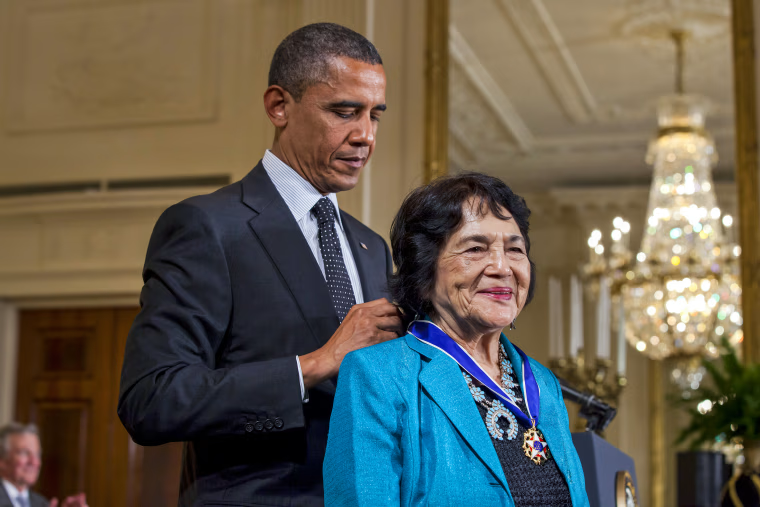
Although Chavez was the face of the movement, Huerta’s organizing was essential to its success in winning farm workers the right to collectively bargain for better wages and working conditions. It was she who coined the slogan “Sí se puede” (Yes we can!), which became the rallying cry of the farmworker movement. This phrase was later used by immigration reform advocates in 2006 and by candidate Barack Obama, in its English translation, in his successful run for the presidency in 2008.
Through protests, strikes, and grassroots campaigns, the UFW helped improve the lives of some of the country’s poorest and most marginalized workers. From the mid-60s to the mid-70s, millions of Americans participated in boycotts of grapes and lettuce. It was a heady time, Huerta recalled in the documentary about her life. “We had this ambience all around you, that you could really change the world.”
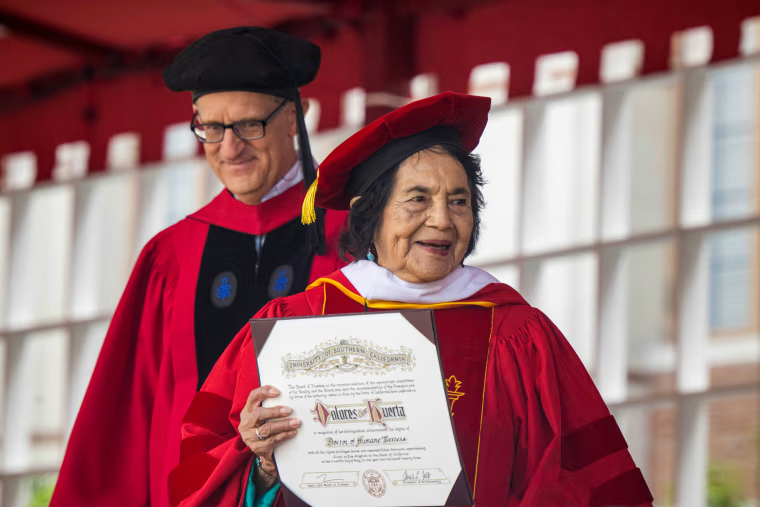
Huerta was “the most famous Latina that has ever been in the labor movement, and the renown was well-earned,” said Matthew J. Garcia, professor at Dartmouth College and author of the 2014 book, “From the Jaws of Victory: The Triumph and Tragedy of Cesar Chavez and the Farm Worker Movement.” “She was extraordinary.”
In her UFW heyday, Huerta cut a striking figure, a fierce young Hispanic woman shouting through a bullhorn, rallying workers and leading marches. This was a rare sight at a time when Latinos had yet to become a political force. She was the embodiment of a “Chicana,” a politically active Mexican American woman claiming her own power.
“Dolores was by Cesar Chavez’ side the whole way through,” said Garcia. “They took what had been a largely rural movement and turned it into a cause that captured the national imagination.” Huerta, he pointed out, brought the UFW’s message into places like Los Angeles and New York City. “She was also a tenacious and strong negotiator of contracts on behalf of farm workers.”
Huerta’s involvement with the UFW came at great personal cost. The mother of 11 children, she left several children behind with relatives when she went to organize farmworkers in the fields. She was often not available for her other children due to the demands of her work.
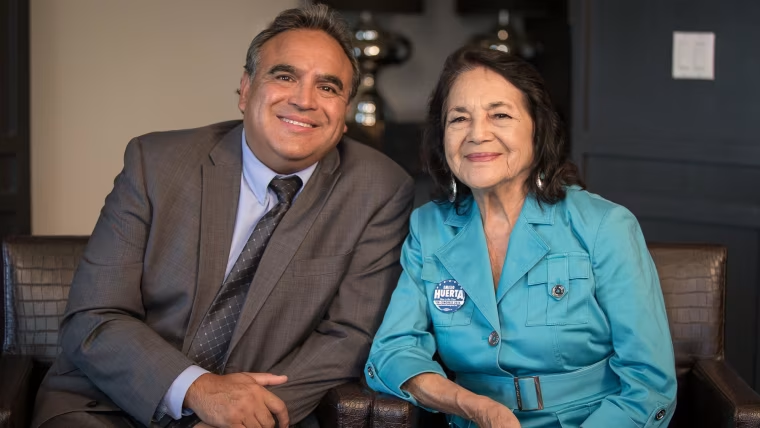
Despite Huerta’s significant efforts with the UFW, her role was often overlooked by the media and historians. “She was as strong a figure as Cesar was — I think she is an unsung hero in many parts of the U.S., and in our history,” said Domingo Garcia, national president of the League of United Latin American Citizens. “Dolores stood for courage. She stood for righteousness and justice when it was unpopular to do so — and when there could be consequences for doing so.”
Huerta helped mobilize working-class and poor people, Garica said, “but she never backed down. She is a profile in courage that every American should know about, especially Latinos and women.”
Within the UFW, Huerta saw gender-based inequality, which led to an awakening of her feminist identity. “When I went to Delano (California) to work with the farmworkers, I had to tamp down my feelings about women in power because there was a different ambiance with the male dominance in the movement. There were a lot of women in the movement, but we saw we needed to be on the executive board,” she reflected in 2017. “The feminists helped me understand why it was important for women to be able to have control of their bodies and control of their lives.”