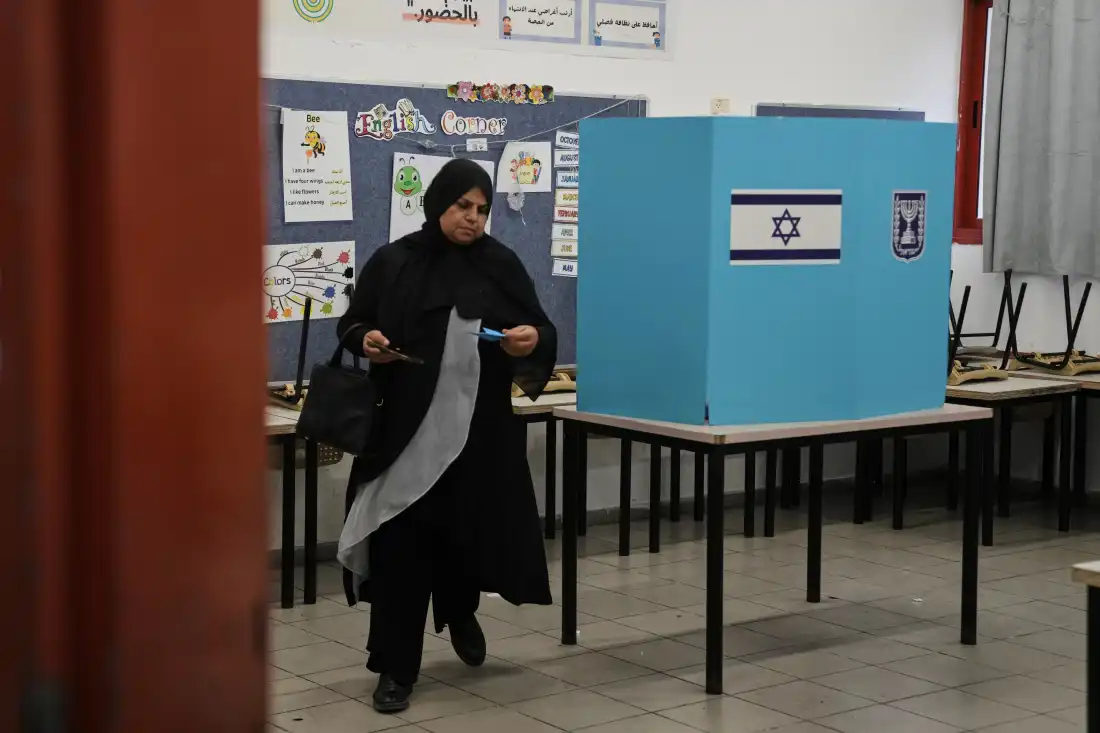
A Palestinian citizen of Israel casts her ballot in the country’s general election at a polling station in Umm al-Fahm, Israel, Oct. 27, 2026
Mahmoud Illean/AP
hide caption
toggle caption
i
Mahmoud Illean/AP
KUFR QASI, Israel — In recent years many Palestinian citizens of Israel shunned elections, believing there was little to gain from participating in the politics of a state which, they say, regularly marginalizes their communities and oppresses their fellow Palestinians in the West Bank and Gaza.
But last month, Palestinian Arabs in Israel came to the ballot boxes in record numbers, helping strip Prime Minister Benjamin Netanyahu’s most far-right government in Israel’s history of its majority, and giving Arab-led parties the votes they needed to become a powerful force in Israeli politics.
“We blocked the government of Netanyahu from continuing,” said Jamal Zahalka, chairman of the High Follow-Up Committee, the main umbrella body representing Palestinian citizens of Israel. “It’s a historical achievement. I think our community found its strength.”
Neither Netanyahu’s coalition, nor his main challenger Gadi Eisenkot’s center-right opposition, reached the threshold of 61 seats needed to form a government. Arab-led parties won 19 out of 120 seats – enough to give them a critical role in the negotiations that will now determine who governs Israel at this turbulent moment in the country’s history.
The election results strike at the heart of the decades-long questions about how Israel defines itself and the role of Palestinian Arabs in its society.
‘The Story Still Isn’t Over’
At a park in the Palestinian-majority town of Kufr Qasim two days after the election, hundreds of people gathered for the annual commemoration of residents gunned down in 1956 by Israeli border police on the opening day of the Suez Crisis in the violent early years of the state, when Israel, Britain and France attacked Egypt after it nationalized the Suez Canal.
“And today we stand here, 70 years later,” the speaker told the large crowd from a podium: “And the story still isn’t over.”
The crowd at this event, mostly dressed in black — some wearing the keffiyeh, the black and white stitched scarf symbolizing Palestinian resistance — mourned not only their lost relatives all those years ago, but also the suffering of Palestinians now: the sharp rise in discrimination against their communities in Israel since the deadly Hamas-led attacks on Israel on October 7, 2023; Israel’s war against Hamas in Gaza that has killed more than 74,000 Palestinians and left a population to survive amid the ruins of the enclave. And the actions of Netanyahu’s extreme right-wing government in the occupied West Bank, where rights groups and the U.N. say it has armed and supported settlers as they force Palestinians from their homes and agricultural lands with unprecedented violence.
Worsening rights inside Israel was one reason, residents of Kufr Qasm told NPR, why so many Palestinian citizens in Israel went to the ballot boxes. “There is no freedom anymore,” said Intisar Sarsur, 65, sitting with relatives beside an olive tree in the park in Kufr Qasim. “ We are seeking for our basic rights as human beings.”
“Everybody that I know participated in the elections. Not one person stayed home,” Sarsur said. She and her family were sharing platters of mutabbaq, a sweet Palestinian layered pastry, and freshly pressed olive oil from this year’s olive harvest – usually a joyous moment in the Palestinian calendar, that she said now felt bittersweet. This year the olive harvest for Palestinians in the occupied West Bank was marred by frequent attacks by Israeli settlers trying to disrupt this economically and culturally significant time of year.
Palestinian citizens of Israel, descendants of those who remained as the state of Israel was established in 1948 (when a majority of the prewar population was forcibly expelled or fled during the war) now make up about 20 per cent of the population.
This election, Arab-led parties received a 64 percent increase in votes compared to the last elections, according to the Central Elections Committee. The gains they made have stirred anger, and even fear, among many on Israel’s political right, who see them as a threat to the country’s Jewish character.
Fear Factor
Netanyahu and his allies made the large Arab turnout a rallying cry. On election day, Netanyahu posted a video calling it an “emergency”. Itamar Ben Gvir, the far-right national security minister, filmed his own appeal at the entrance to Kufr Qasim: “If you want this country to remain Jewish and Zionist … then get out and vote!”
As results came in, Netanyahu’s Likud party went further. It claimed Arab parties had “stolen” the election through bribery, threats and forgery, and later warned of a foreign takeover of the Knesset and the “Islamization of Israel.” The party has made no evidence public. Police say they found no basis for the claims, and election officials say there was no widespread fraud. The head of the elections committee separately asked the Shin Bet security service to investigate suspected foreign funding of efforts to boost Arab turnout. But he and the attorney general say the vote was conducted properly and the results were not compromised.
The messaging by Netanyahu’s bloc is widely seen as an attempt to prevent Eisenkot’s center-right grouping from partnering with Arab parties — a reality that would give Eisenkot the majority he needs to form a government. But the sharp rise in anti-Arab sentiment since the Oct. 7, 2023 attacks, in which some 1,200 people were killed, has made an alliance with any Arab party potentially politically treacherous and could cause other Jewish right wing members of his bloc to split off in fury.
Eisenkot is not a natural ally for Arab parties either. A former military chief of staff whose son was killed fighting in Gaza, he served as an observer in Netanyahu’s war cabinet early in the war. And he still cuts a hawkish figure. As a general, he is credited with formulating the “Dahiyeh doctrine,” which he laid out in 2008: using “disproportionate force” against villages from which militants fire on Israel, which he called “not civilian villages” but “military bases.” It is named after Beirut’s southern suburbs, a Hezbollah stronghold that Israel largely decimated in heavy bombardment in 2006.
So Arab parties are divided on how to use the power they gained in this election. Ra’am, a socially conservative Islamist party, campaigned on joining a governing coalition and put a Jewish former police official second on its list. But for now the Joint List alliance that won 11 of the 19 Arab-led party seats in this election won’t formally partner with Eisenkot. Its leaders have said they could back his government from the outside, but won’t join it, citing Israel’s ongoing war in Gaza and its occupation of the West Bank.
President Isaac Herzog has been consulting with parties over who they would support to try to form a coalition. He is expected to announce which candidate he’ll give a mandate to next week, to try to form a coalition. That candidate will have 28 days and can ask for a further two-week extension. If he fails, another candidate is given only 28 days (without extension) to try to form a government. And if no one manages to form a coalition, there will be repeat elections next year.
In Kufr Qasim, as the readings and re-enactments of the 1956 killings unfurled on stage, Mansour Shaaban said he would vote again in an instant. Aged 33, this was the first election he had voted in. But now he said it’s necessary to try to stop what he called the racism and oppression of Palestinians by Israel’s extreme right. “There are Israelis we eat with and live alongside,” Shaaban said. But Netanyahu and Ben-Gvir and other leaders in these last years he said “are making it impossible to co-exist,” he said.
“Even if we don’t succeed to create change this time,” he said, now right-wing Israeli politicians know that Palestinian citizens of the country have found their voice.
Nuha Musleh contributed to this report