Kanchan and her son sit on his bed, next to Kamal, a relative, in the Muslim-majority neighborhood Bela Slum in New Delhi, India, October 13, 2026.
Elke Scholiers for NPR
hide caption
toggle caption
i
Elke Scholiers for NPR
NEW DELHI — Like many Indians, Kanchan has one name and lives in hardscrabble quarters. Her home is built of tin and a tarp, constructed under a flyover in the capital New Delhi. And like many on the margins, Kanchan was proud of her right to vote — a rare equalizer in unequal India.
“It’s important, because it shows we are citizens,” Kanchan said on a recent October day, sitting on a plastic chair as vehicles trundled overhead.
But a few weeks ago, Kanchan said about 500 adults were deleted from their voter roll in this community, which resides around a bridge. They found out through another resident who is allowed to examine the voter rolls as a representative of a political party.
They were among an estimated 130 million names that were deleted during a revision of voter rolls that began last year in June.
The number is an estimate by Yogendra Yadav, an elections specialist and prominent critic of Indian Prime Minister Narendra Modi’s ruling Hindu nationalist Bharatiya Janata Party (BJP). Nevertheless, the BJP has cited the figure as authoritative in its defense of the voter roll revision. The rolls once had listed 980 million names.
“The government is choosing the people that support them,” Kanchan told NPR, accusing the BJP of engineering voter rolls to disenfranchise communities opposed to the party. That is a widespread belief among critics of the voter revision process, including a former chief election commissioner of India, SY Quraishi. “Normally voters choose the government, here the government was choosing the voters,” said Quraishi, who served in that role from 2010 to 2012.
India’s election commission, which is overseeing the voter revision, is ostensibly independent. But critics accuse chief commissioner Gyanesh Kumar of being partisan to Prime Minister Modi’s party. And it is the party, not the commission, that has mounted a defense of the revision. In a video issued on the BJP’s YouTube channel in early October, it said those approximately 130 million deleted names were of people who had died, had duplicate entries, had moved residences or were otherwise absent.
Kanchan said in her community, people were deleted on the basis they had relocated, even though an election official came to visit and she “made me sign and hand over the form to her.”
And activists helping Indians get back on the voter roll say many others were deleted because they could not provide information that had never been demanded of voters before, like demonstrating that their parents or grandparents voted in elections more than two decades ago. Others were told to prove who they were after discrepancies appeared between how their names were spelled on voter rolls and how they were spelled on enumeration forms that were distributed to some, but not all, voters.
One notice was handed to Nasir Malik, a community activist in a New Delhi quarter called Mustafabad, who waved it around on a recent day. “This makes no sense,” he told NPR. “If this was a problem, how did I vote in elections before this?”
Name spelling discrepancies are so common in India that experts said they were not regarded as a problem in previous voter roll revisions, as long as the local election official believed they were dealing with the same person.
In a downtown New Delhi café, a lawyer who has filed multiple petitions against the voter revision process said his country once took pride in ensuring that every eligible adult could vote. Now, the burden of proof was flipped onto citizens to prove who they were, triggering “the largest disenfranchisement exercise in human history,” said the lawyer, Kaustubh Chaturvedi. “It’s an unconscionable process. What you’ve really done is you’ve purged the right to the vote from almost all of those who need it most.”
It is the largest disenfranchisement by numbers. By ratio, the Jim Crow laws led to higher percentages of people being disenfranchised in the United States, according to historian Carole Anderson, who has written extensively about voter suppression of Black communities.
For 27-year-old Kanchan, in the New Delhi community around the bridge, her right to vote wasn’t just about voting.
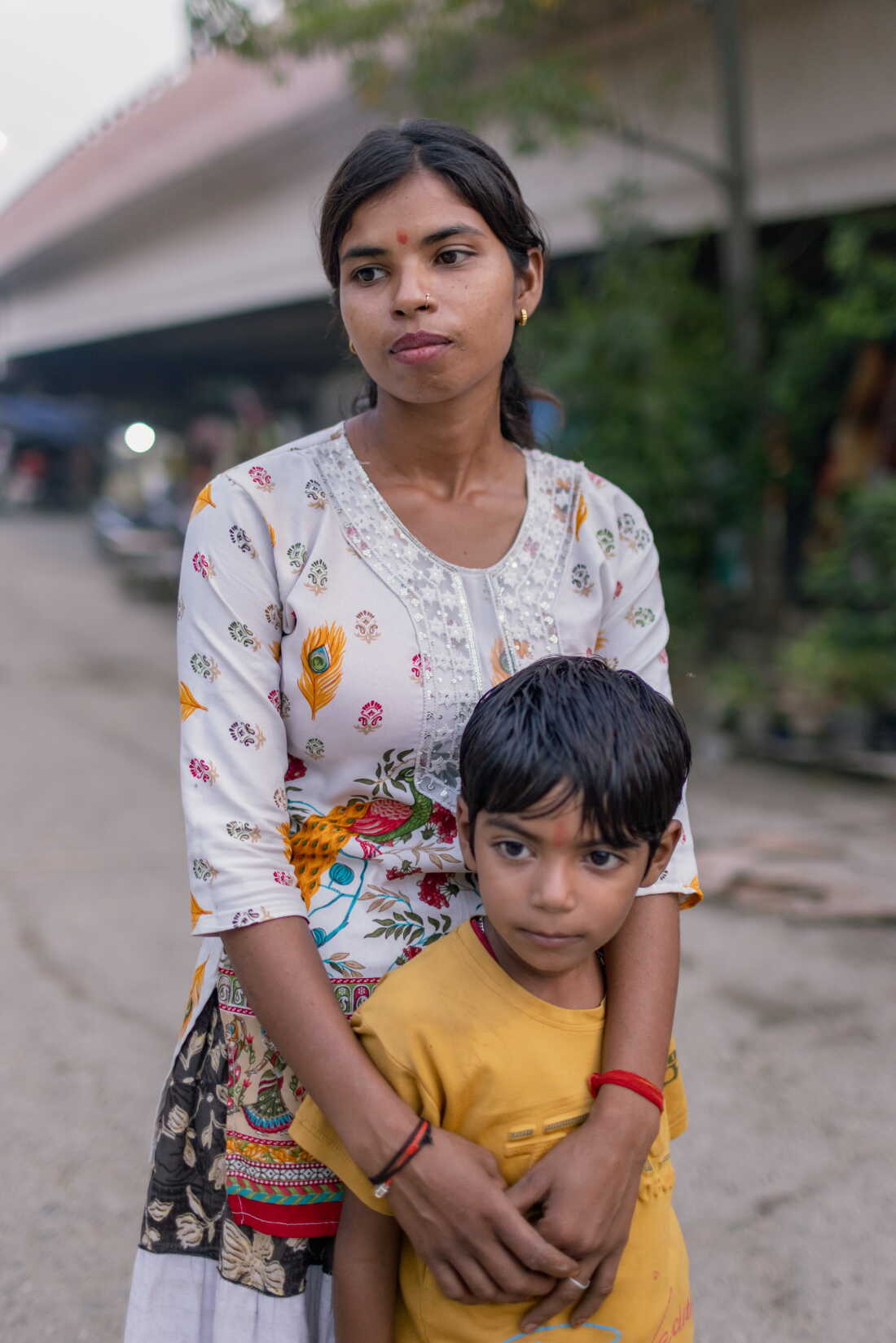
Kanchan and her son pose at home in the Muslim-majority neighborhood Bela Slum in New Delhi, India, October 13, 2026.
Elke Scholiers for NPR
hide caption
toggle caption
i
Elke Scholiers for NPR
She’s raising her 6-year-old son alone after her husband, a food delivery driver, was killed in a road accident four years ago. She supplements her teaching income with a monthly government stipend equivalent to $25, and free monthly food staples of rice, wheat and sugar. She feared authorities would deny her those services by calling into question her citizenship, because she was struck off voter rolls. “They’ll cut us off from everything slowly,” she fretted.
Those fears were particularly triggered after government officials in some states ruled by the BJP vowed to strike people off assistance programs if they’d been deleted off voter rolls.
After an outcry over voter deletions in September, the election commission said it worked with “complete integrity.” It said officers would help those deleted from voter rolls to be reinstated. Sunil Kumar, a senior election official in Kanchan’s constituency of Chandi Chowk told NPR that his department was working to get Kanchan’s community back onto voter lists.
Any help now has come too late for some disenfranchised Indians, like Malika, who only has one name.
In the working-class quarter of Mustafabad, Malika worried she’d now be accused of being an illegal migrant, because she was struck off voter rolls. Her concern stems from the claim by the powerful interior minister, Amit Shah, who first said the voter revision would be aimed at detecting, deleting and deporting infiltrators. And while authorities tried to quell protests against the voter revision deletions in October, Shah described those opposing the voter revision as protecting infiltrators. That is often a dog whistle in India for Muslims from neighboring Bangladesh.
Malika, who is Muslim, says her voter ID was one of the few ways she could prove who she was. She was born without a birth certificate, says she never went to school and that her parents died when she was young. “I had no elders,” she said. “I pretty much raised myself.”
She said she was struck off her old voter roll in Mustafabad after she moved two hours away — she couldn’t afford the rent after her husband was killed in communal violence here six years ago. More than 40 people were killed, mostly Muslims, by Hindu mobs. Malika now commutes to Mustafabad each day where she works as a cleaner, making $80 a month, which she said barely feeds her three children.
She said no election officer ever visited her in her new digs to take down her details, which they were supposed to do so she could get back on the voter roll. Malika said she’d visited her local officer on a recent Friday, but she lost a day’s work without resolving anything.
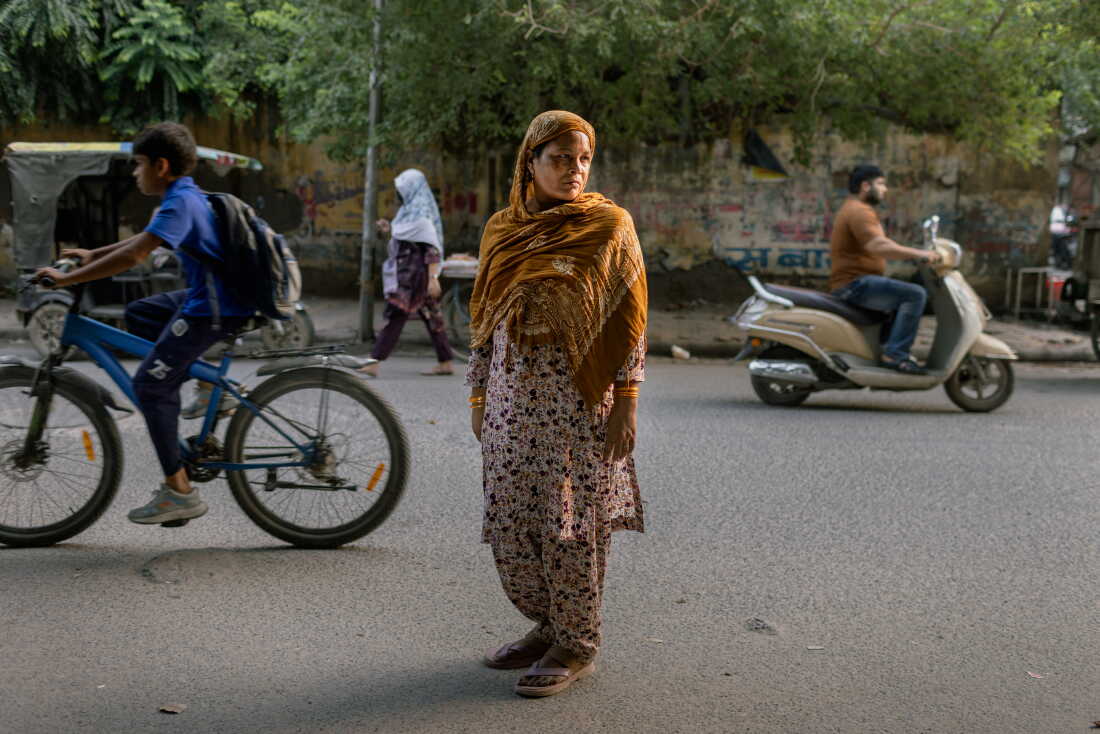
Malika, a cleaning lady, poses in the Muslim-majority neighborhood of Mustafabad in New Delhi, India, October 13, 2026.
Elke Scholiers for NPR
hide caption
toggle caption
i
Elke Scholiers for NPR
“These people, the government officials — they like to sit in their air-conditioned offices and they make certain rules,” she said, referring to the voter revision process. “But they really need to come to the ground and see how it is,” she said, “to work in the hot sun, to be poor like we are.”
For now, she signals her identity through the plastic bangles on her arms, colored orange, white and green — the colors of the Indian flag. She smiled as she jangled them. “This is my India too,” she said.