Washington — A federal appeals court on Monday dismissed the Justice Department’s effort to force California election officials to set aside thousands of ballots that the Trump administration claims may have been cast by alleged noncitizens.
The U.S. Court of Appeals for the 9th Circuit said in a 2-1 decision that it lacked jurisdiction over the appeal and granted a motion by the top elections official from Los Angeles County to dismiss the effort.
The federal government, Judges Mark Bennett and Gabriel Sanchez said, failed to allow a federal district court “adequate opportunity” to consider its request for temporary relief. Judge Patrick Bumatay dissented.
The two judges faulted the Justice Department for waiting until less than three weeks before the midterm elections on Nov. 3 to file its lawsuit and only seeking a temporary restraining order from the district court last week. They also pointed out that the department had sought a temporary restraining order as California was already processing ballots.
“The United States’s claimed emergency, at least in part, is a self-constructed one,” the 9th Circuit said in an unsigned opinion. “At least part of the delay here is attributable to the United States’s own delay in filing suit, in realizing that existing California state law governs the issuance and processing of ballots, in recognizing that California has millions of registered voters and processes ballots on a schedule aligned with that scale, and in communicating to the court its desired relief.”
Both Bennett, appointed by President Trump, and Sanchez, tapped by former President Joe Biden, authored concurring opinions. Bennett said that even if the court had reached the legal merits of the Justice Department’s effort, he would have rejected its bid to force California to set aside the ballots that may be cast by ineligible voters.
Bumatay, who dissented, said the federal government has an interest in protecting the integrity of federal elections.
“The question — does the federal government have the power to stop this potential attack on the integrity of our elections? Under both federal law and the Constitution, the answer must be ‘yes,'” the judge, a Trump appointee, wrote. “Simply, the federal government has a sovereign interest in safeguarding federal elections and ensuring that the votes of noncitizens do not undermine our electoral results.”
California Gov. Gavin Newsom said the 9th Circuit’s decision is a “positive development and a welcome speed bump to Trump’s disgusting attacks on the Constitution and our country’s democracy.”
“Trump is illegally trying to seize powers in the Constitution entrusted to others so he can stay in power. This lawsuit is just the latest step,” he said in a statement. “Make no mistake: Trump’s assault on democracy won’t slow down.”
The fast-moving dispute over California’s mail ballots was filed earlier this month after Acting Deputy Attorney General Trent McCotter sent letters to California’s secretary of state and the top election official in Los Angeles County, Dean Logan, which gave them 48 hours to review a list of more than 20,000 registered voters who the Trump administration believes are “likely” noncitizens and were sent mail ballots.
Los Angeles County told McCotter in a letter dated Oct. 15 that the list of suspected noncitizens contained addresses of registered voters throughout the state, and said his letter did not include information about how the list had been compiled. The county also told McCotter the letter did not provide any information as to how the county was to confirm citizenship status.
A lawyer for Los Angeles County said the Justice Department was asking Logan, the registrar-recorder and county clerk, “to engage in an unlawful course of conduct.”
On the same day that the county sent McCotter its response, the Justice Department sued California, Secretary of State Shirley Weber and Logan, and claimed that state officials had failed to work collaboratively with the federal government to identify any noncitizens registered to vote in the state and protect the integrity of elections.
The Justice Department asked a federal judge to order California to put aside mail ballots of people it has identified as suspected noncitizens and to independently verify their citizenship status before counting their ballots.
The judge overseeing the case, David O. Carter, scheduled a hearing for Tuesday afternoon on the Trump administration’s request for a temporary restraining order. But the following day, the Justice Department took the extraordinary step of filing an appeal with the 9th Circuit.
Government lawyers argued that because Carter had not yet ruled on their request for emergency relief, his “silence” amounted to a “constructive denial” of their effort to require California to set aside the mail ballots returned by the voters on the Trump administration’s list.
The three-judge 9th Circuit panel then held a rare Sunday oral argument session, during which at least two of the judges appeared skeptical of the Justice Department’s request for the court to step in.
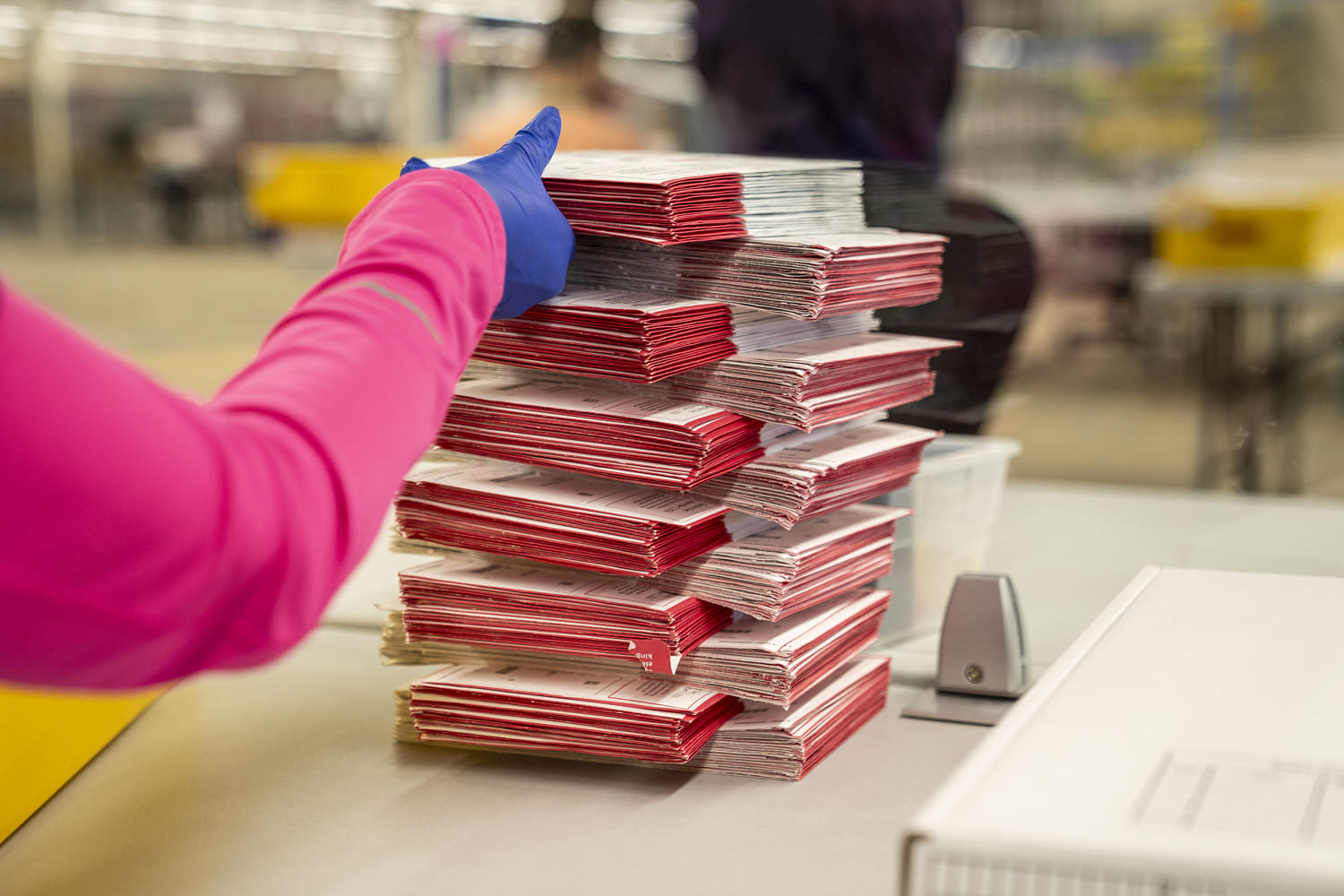
The 11th-hour lawsuit against California officials was filed less than three weeks before the November midterm elections, when voters across the country will decide which party controls the House and Senate. In California, elections officials began mailing ballots in early October. Los Angeles County has already processed an estimated 550,000 mail ballots, according to court filings.
In the months leading up to the midterms, Mr. Trump has attempted to exert more federal control over elections and pushed Congress to enact a package of voting regulations, including requiring proof of citizenship to register to vote.
The president has repeatedly claimed that hundreds of thousands of noncitizens are registered to vote in federal elections, including more than 190,000 in California. Both federal and California law prohibit noncitizens from voting.
But the Department of Homeland Security has declined to provide California election officials with an explanation of how it identified those alleged ineligible voters.
Instead, in its lawsuit, the Justice Department said the DHS compares information about voter rolls with internal data to identify potential matches between registered voters and possible noncitizens, and then uses “third-party software” to identify matches between voter information and data about that person compiled by the software program. The Trump administration also said it uses internal records and data from the Social Security Administration.
But California officials have argued that the Justice Department’s lawsuit does not contain any allegations that those suspected noncitizens will even vote unlawfully in the general election. Lawyers for Logan, the Los Angeles County registrar-recorder and county clerk, also said that the relief sought by the Trump administration exceeds the executive branch’s constitutional authority.
The Constitution’s Elections Clause gives states the power to set the “times, places and manners” of congressional elections unless Congress steps in.
Amid the ongoing litigation, lawyers for Logan and Los Angeles County said they attempted to analyze the data from the Trump administration’s list of alleged noncitizens. The list includes 7,035 records with county addresses, they said. County officials reviewed a sample of 200 of those records and found 112 of them correspond to voter registrations that were canceled or inactive, so no ballot was mailed to that person.
Most of the people in the sample had never voted, and more than one-quarter of them listed a birthplace in the U.S., according to a Los Angeles County election official.
Federal prosecutors sent more letters to at least 18 other California county registrars on Friday with lists of alleged noncitizens registered to vote. The Justice Department demanded the elections officials set aside ballots cast by those it believes are ineligible to vote.
The Justice Department could ask the full 9th Circuit to reconsider its appeal, and the panel gave the government until 7 p.m. local time to make such a request.